
Understanding the Meaning of E-Commerce
Before diving into the four types, it helps to understand what e-commerce actually means. Simply put, e-commerce refers to buying and selling goods or services over the internet. Whenever someone orders shoes from an online store, purchases a digital course, or books a hotel online, they are participating in e-commerce.
The concept may sound simple, but the ecosystem behind it is enormous. E-commerce involves payment systems, online marketing, logistics, customer service, inventory management, cybersecurity, and even artificial intelligence. What started as small online stores in the early days of the internet has evolved into a multi-trillion-dollar global industry. Some businesses operate entirely online without ever opening a physical shop.
The reason e-commerce exploded in popularity is easy to understand. Consumers love convenience. Nobody wants to spend hours driving from store to store when they can compare products in seconds from their phone. Businesses also benefit because they can reach customers worldwide instead of depending only on local traffic.
Another reason for its growth is mobile shopping. Recent statistics show that mobile commerce now accounts for a huge percentage of online sales globally. Social media platforms have also become shopping destinations, turning apps like TikTok and Instagram into digital marketplaces where people discover products while scrolling through videos.
Why E-Commerce Became So Popular
Imagine opening a store that never closes. That’s basically what e-commerce offers. Traditional stores operate within business hours and geographical limits. Online stores can generate sales 24 hours a day from customers across the world.
The pandemic years accelerated online shopping habits dramatically, but the trend didn’t slow afterward. Consumers became comfortable with digital payments, fast delivery, and online customer support. Today, people expect brands to have online stores. If a company doesn’t exist online, many customers question whether it’s trustworthy or outdated.
Another major factor is price comparison. Online shoppers can instantly compare prices from multiple sellers before buying. This creates a competitive market where businesses constantly improve their offers, shipping speeds, and customer experiences.
Technology also plays a huge role. AI-powered recommendations, personalized shopping experiences, and live chat support have made online shopping smarter than ever. According to recent industry reports, AI-driven shopping experiences and social commerce are among the biggest e-commerce trends shaping 2026.
How Online Buying Changed Consumer Behavior
Consumer behavior today is very different from what it was ten years ago. People no longer rely solely on advertisements or TV commercials before making a purchase. Instead, they read reviews, watch unboxing videos, compare ratings, and check social media opinions.
Studies show that the vast majority of consumers check reviews before buying products online. Trust has become the currency of modern e-commerce. A business with poor reviews can lose customers instantly.
Speed also matters more than ever. Customers expect quick websites, simple checkout systems, and fast delivery. If a site takes too long to load, many shoppers leave immediately. Cart abandonment rates remain extremely high globally, showing how impatient online consumers can be.
Social media has also blurred the line between entertainment and shopping. A person might watch a funny video and buy a product seconds later without even planning to shop. This shift has made e-commerce more impulsive, interactive, and emotionally driven.
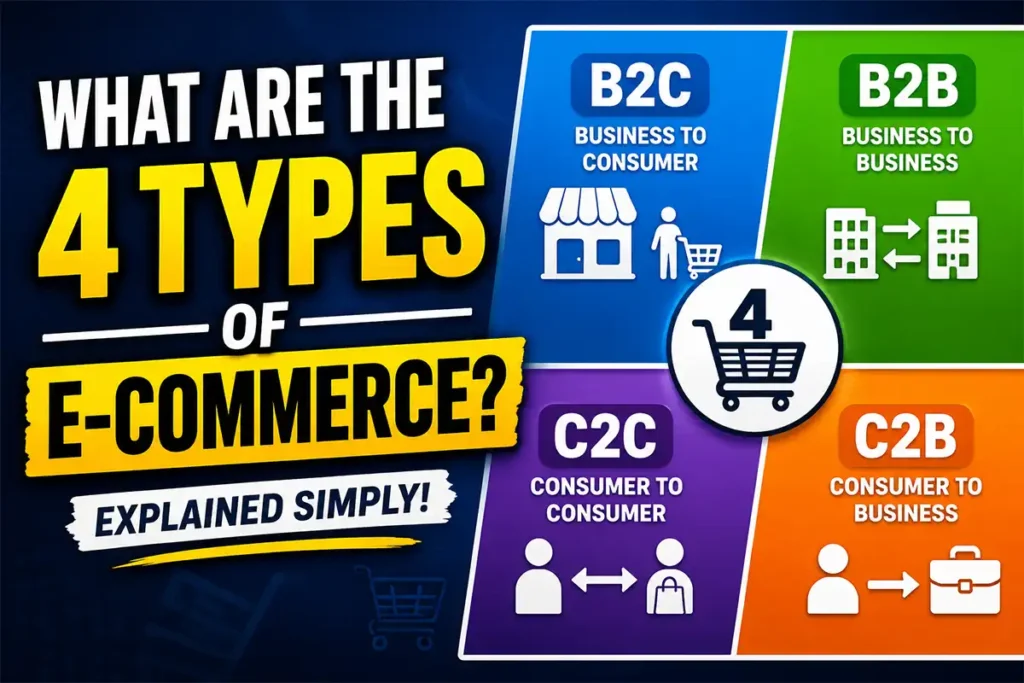
The 4 Main Types of E-Commerce
Business to Consumer (B2C)
The most common and recognizable type of e-commerce is Business to Consumer, also known as B2C. This model happens when a business sells products or services directly to individual customers.
Think about ordering clothes from an online fashion store or buying a smartphone from a retailer’s website. Those are classic B2C transactions. The business targets everyday consumers and tries to convince them to purchase products through advertising, promotions, and branding.
B2C businesses focus heavily on customer experience. They invest in website design, product photography, customer support, and digital marketing because competition is intense. Customers have endless options online, so businesses must stand out.
One of the biggest strengths of B2C e-commerce is scalability. A small store can start locally and eventually sell internationally without opening physical branches. This is why many entrepreneurs choose B2C when starting online businesses.
Examples of B2C Companies
Some of the most famous e-commerce companies in the world operate under the B2C model. Examples include:
| Company | Main Products | Type |
|---|---|---|
| Amazon | General retail | B2C |
| Nike | Sportswear | B2C |
| Apple | Electronics | B2C |
| Walmart | Retail products | B2C |
B2C businesses dominate online retail because they serve massive audiences. Reports show that online retail sales now represent over 20% of total retail transactions globally.
Business to Business (B2B)
The second major type is Business to Business, or B2B. In this model, businesses sell products or services to other businesses instead of individual consumers.
At first glance, B2B may sound less exciting, but it actually represents a massive part of the e-commerce economy. Factories buying raw materials, software companies selling enterprise tools, and wholesalers supplying retailers are all examples of B2B commerce.
B2B transactions are usually larger and more complex than B2C sales. A consumer might buy one laptop, but a company could purchase 500 laptops for employees. The sales cycle is often longer because businesses compare suppliers carefully before making decisions.
Trust and long-term relationships are extremely important in B2B e-commerce. Companies want reliable suppliers, stable pricing, and consistent service. Many B2B transactions involve contracts, negotiations, and customized pricing structures.
Examples of B2B Platforms
Here are common examples of B2B e-commerce platforms:
| Platform | Industry | Purpose |
|---|---|---|
| Alibaba | Wholesale | Supplier marketplace |
| Salesforce | Software | Business CRM |
| Shopify Plus | E-commerce tools | Enterprise commerce |
| Grainger | Industrial supplies | B2B retail |
Recent market reports show that B2B e-commerce is growing rapidly, with trillions of dollars flowing through digital business transactions annually.
Consumer to Consumer (C2C)
The third type is Consumer to Consumer, commonly known as C2C. This model allows individuals to sell products or services directly to other individuals through online platforms.
Imagine selling a used phone on an online marketplace or listing handmade crafts for buyers. The platform acts like a digital middleman connecting people who want to buy and sell.
C2C e-commerce became incredibly popular because it lowered the barriers to entry. You no longer need a physical store or a large investment to start selling. Anyone with internet access can become a seller within minutes.
The rise of C2C platforms also created the “side hustle economy.” Millions of people now earn extra income by reselling products, flipping collectibles, or offering handmade goods online.
Popular C2C Marketplaces
Some well-known C2C platforms include:
- eBay
- Facebook Marketplace
- Etsy
- Craigslist
- Vinted
The success of C2C platforms comes from community trust and convenience. Buyers often look for lower prices, rare items, or second-hand bargains. Sellers benefit by turning unused items into cash.
Consumer to Business (C2B)
The fourth type of e-commerce is often the least discussed but increasingly important. Consumer to Business (C2B) happens when individuals provide products or services to businesses.
Freelancing is one of the best examples of the C2B model. A graphic designer creating logos for companies, a photographer licensing images, or an influencer promoting products are all part of C2B commerce.
This model flipped the traditional business structure upside down. Instead of companies always controlling the market, individuals can now offer value directly to brands and businesses.
The rise of the creator economy has accelerated C2B dramatically. Social media influencers, YouTubers, and freelance professionals can build personal brands and collaborate with businesses worldwide.
How Freelancing Fits Into C2B
Freelancing platforms like Fiverr and Upwork are perfect examples of C2B marketplaces. Businesses hire individuals for tasks such as:
- Writing
- Graphic design
- Video editing
- SEO
- Marketing
- Programming
This model gives businesses flexibility while allowing individuals to work independently. Remote work culture and digital communication tools made C2B stronger than ever in recent years.
Comparing the 4 Types of E-Commerce
Key Differences Between Each Model
Here’s a simple comparison table to understand the differences:
| Type | Seller | Buyer | Example |
|---|---|---|---|
| B2C | Business | Consumer | Amazon |
| B2B | Business | Business | Alibaba |
| C2C | Consumer | Consumer | eBay |
| C2B | Consumer | Business | Fiverr |
Each model serves different audiences and operates differently. B2C focuses on emotional marketing and fast purchases, while B2B emphasizes efficiency and long-term partnerships.
C2C depends heavily on trust between individuals, while C2B thrives on talent, creativity, and personal branding. Understanding these differences helps entrepreneurs choose the right business direction.
Which E-Commerce Model Is Most Profitable?
There isn’t a single answer because profitability depends on execution, market demand, and scalability. B2C businesses can scale quickly but face intense competition. B2B companies often enjoy larger transactions and stronger customer loyalty.
C2C platforms can generate revenue through commissions and listing fees, while C2B creators may build highly profitable personal brands with low startup costs.
Many modern companies combine multiple e-commerce models. For example, Amazon operates as both B2C and C2C through its marketplace system. Hybrid models are becoming increasingly common.
Emerging Trends in E-Commerce
Mobile Commerce and Social Commerce
Mobile commerce is no longer the future — it’s the present. Reports show that mobile shopping now represents a majority share of online transactions globally.
Social commerce is growing even faster. Platforms like TikTok Shop have transformed how consumers discover products online. Instead of searching directly, users encounter products naturally while watching videos and live streams. Recent reports indicate explosive growth in social commerce worldwide.
This trend is changing digital marketing completely. Businesses now focus on short-form video content, influencer collaborations, and live shopping experiences to drive sales.
AI and Personalization in Online Shopping
Artificial intelligence is reshaping e-commerce at lightning speed. AI tools analyze customer behavior, recommend products, predict buying patterns, and automate support systems.
Personalized shopping experiences increase conversion rates because customers feel understood. Imagine entering a store where the salesperson already knows your style and preferences. That’s exactly what AI personalization aims to achieve online.
AI chatbots also help businesses respond instantly to customer questions. This improves customer satisfaction while reducing operational costs.
Experts predict that AI-powered shopping assistants and personalized product recommendations will become standard features for online stores in the coming years.
Advantages of E-Commerce Businesses
Lower Startup Costs
One of the biggest advantages of e-commerce is affordability. Starting an online store is usually much cheaper than opening a physical shop. Entrepreneurs can avoid expensive rent, utilities, and large staff costs.
Platforms like Shopify and WooCommerce make launching an online business surprisingly accessible. Even small businesses can compete globally with smart marketing and good branding.
Automation also helps reduce costs. Inventory systems, email marketing tools, and AI customer support can streamline operations significantly.
Global Reach and Automation
Traditional stores depend heavily on location. E-commerce removes geographical limitations. A business in Tunisia, the United States, or Japan can sell products internationally with the right logistics setup.
Automation is another major advantage. Businesses can automate emails, payments, shipping notifications, and customer support processes. This allows companies to scale faster without proportionally increasing staff.
Cross-border e-commerce is becoming more important every year as logistics and payment technologies improve globally.
Challenges of Running an E-Commerce Business
Competition and Customer Trust
While starting an online business is easier than ever, competition is brutal. Millions of online stores fight for customer attention every day.
Building trust is one of the hardest parts of e-commerce. Customers worry about scams, fake reviews, poor-quality products, and delayed shipping. Businesses must invest heavily in branding, customer service, and secure payment systems.
Reviews and social proof now influence buying decisions heavily. A few negative reviews can damage a company’s reputation quickly.
Shipping and Logistics Issues
Shipping remains one of the biggest challenges in e-commerce. Customers expect fast and affordable delivery, but logistics can become expensive and complicated.
Stock shortages, customs issues, and delayed deliveries can hurt customer satisfaction badly. Industry reports suggest that stockouts cause major revenue losses for online businesses.
Successful e-commerce companies often prioritize logistics infrastructure because delivery speed has become a competitive advantage.
How to Choose the Right E-Commerce Model
Choosing the right e-commerce model depends on your goals, budget, skills, and target audience. If you want to build a consumer brand, B2C may be ideal. If you prefer wholesale or enterprise solutions, B2B could be more profitable.
Creative professionals and freelancers often succeed with the C2B model, while individuals selling second-hand products may prefer C2C platforms.
Ask yourself these questions:
- Who are you selling to?
- What problem are you solving?
- Do you want recurring customers or one-time sales?
- Are you building a brand or offering services?
The best model is the one that aligns with your strengths and market demand.
Conclusion
The four types of e-commerce — B2C, B2B, C2C, and C2B — form the foundation of the digital economy. Each model connects buyers and sellers differently, creating unique opportunities for businesses and individuals alike.
E-commerce continues evolving rapidly through mobile shopping, AI personalization, social commerce, and global digital connectivity. Businesses that understand these models and adapt to changing consumer behavior will have a major advantage in the years ahead.
Whether you’re planning to launch an online store, become a freelancer, build a marketplace, or simply understand how digital commerce works, learning these four e-commerce models is the perfect starting point.
FAQs
1. What is the most common type of e-commerce?
The most common type is B2C (Business to Consumer) because it includes online retail stores selling directly to customers.
2. Is Amazon B2B or B2C?
Amazon mainly operates as a B2C platform, but it also includes B2B and C2C elements through services like Amazon Business and marketplace sellers.
3. What is an example of C2B e-commerce?
Freelancers offering services to businesses on platforms like Fiverr or Upwork are examples of C2B e-commerce.
4. Why is e-commerce growing so fast?
E-commerce is growing due to convenience, mobile shopping, fast internet access, AI personalization, and social media shopping trends.
5. Which e-commerce model is best for beginners?
B2C is often the easiest starting point for beginners because online store platforms make setup relatively simple.